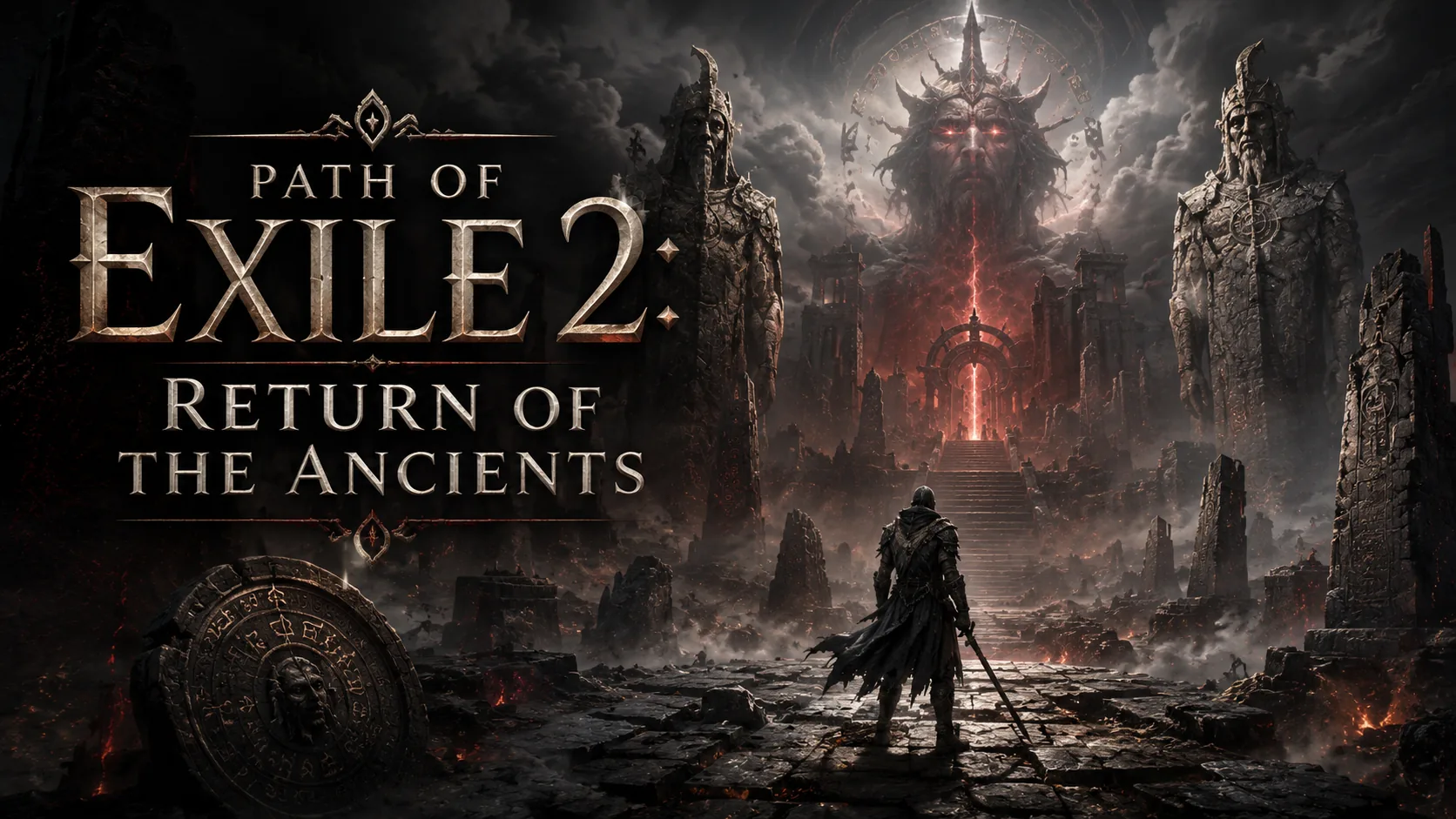
Path of Exile 2: Return of the Ancients — Everything Coming on May 29th
If you've been keeping an eye on PoE2 but haven't jumped back in, the timing is about to get very compelling.
On May 29, 2026, Grinding Gear Games drops update 0.5.0 — Return of the Ancients.
This isn't a minor content patch. GGG themselves have framed it as the final major expansion before the 1.0 full release — the update that turns early access into something that actually feels complete. The reveal stream happened May 7th, and the community reaction ranged from cautiously optimistic to genuinely hyped, depending on who you ask.
So let's break down what's actually coming and why it matters.
The Big Picture: Why 0.5.0 Is Different
The criticism PoE2 has faced since early access launched has been pretty consistent: the endgame feels aimless. You grind maps. You chase bosses through RNG drops. You run out of things that feel meaningful before you run out of things to do.
Jonathan Rogers addressed this directly in the post-reveal Q&A. The stated goal for 0.5.0 is to give the endgame an actual ending — a sense of completion that doesn't require you to grind for three hundred hours just to feel like you've seen everything. That's a philosophical shift, not just a content drop. Whether GGG pulls it off is something we'll find out on the 29th, but the design intent is clearly different from what they shipped in 0.4.
The expansion adds:
- A brand-new challenge league: Runes of Aldur - A completely redesigned Atlas and endgame progression - 5 new endgame storylines - 15 new bosses (including 4 new Pinnacle encounters) - 2 new Ascendancy classes - Over 40 new Unique items - An in-game build guide system - 50+ hours of new endgame content
That's a substantial list. Let's go through what matters most.
The Runes of Aldur League
The league mechanic for 0.5.0 centers on Ezomyte Runesmithing — an ancient Kalguuran crafting tradition you're helping an NPC named Farrow rediscover.
Here's how it works in practice:
As you move through zones, you'll encounter Ezomyte Remnants — ancient structures left behind by an old civilization. When you find one, you interact with it and inscribe runic symbols from a selection of available runes. The runes you choose determine what crafting reward you get. But — and this is the core tension — the rune inscription also reanimates and empowers the nearby undead enemies.
Choose a Fire Rune? The enemies that wake up deal fire damage. Stack multiple rune slots as you progress through the league and unlock more complex combinations, and the empowered enemies scale with that. Higher risk, better crafting outcome.
After you defeat the revived enemies, you claim the crafted item. The combinations you discover get recorded in a Runebook so you can repeat useful setups on future encounters.
This is a risk-reward loop that PoE players will recognize immediately. It gives you choices with real consequences rather than just passive triggers.
The crafting currency earned through this system is called Verisium, which you bring to the Verisium Anvil in town to use Runeforging.
Runeforging and Runic Ward — The New Crafting Layer
Runeforging is the NPC Farrow's specialty and one of the deeper systems in 0.5.0. At the Verisium Anvil, you can:
- Add Runic Ward to armor pieces - In endgame, upgrade Unique items — including applying it to low-level Uniques to make them viable at higher tiers
- Alter or add modifiers to existing gear
Runic Ward is the genuinely new mechanic here. Think of it as a secondary buffer that sits beyond your Life pool. If your Life hits zero, the Runic Ward absorbs the overflow. Only when both are depleted do you die. In practical terms, it's a second health bar that can prevent one-shots under the right conditions.
But it's not just defensive. Certain new skills — the Runic Skills — consume Runic Ward instead of Mana or Life. No attribute or weapon requirements, universal to all classes. This creates a resource decision: do you use Runic Ward as a safety net, or spend it as fuel for offensive output?
That tradeoff is going to be central to build planning in 0.5.0. Expect streamers and theorycrafters to spend the first week working out exactly where the breakpoints are.
The Two New Ascendancies
Spirit Walker (Huntress)
The Spirit Walker is the beast master fantasy done through the lens of spiritual communion rather than literal pet summoning.
The core mechanic involves channeling three distinct animal spirits:
- Stag — mobility-focused, burst potential - Bear — sustain and damage reduction - Owl — projectile abilities and dodge
You can specialize into individual spirits or unlock Sacred Unity by investing across all three simultaneously, which combines their effects into a powerful unified form.
There's also an Idolatry path that scales companion bonuses based on Idols socketed into your equipment. If you like playing support-adjacent or summon-oriented builds, Spirit Walker looks like it was built specifically for you.
And — this is the part that got the most attention in the reveal — Spirit Walkers can actually tame unique beast-type bosses encountered in the world and command them. Whether this turns out to be as impactful as it sounds is something we'll find out in week one.
Martial Artist (Monk)
The Martial Artist is faster, weirder, and probably the Ascendancy that's going to produce the most highlight clips in the first two weeks.
The defining system is Hollow Techniques — mechanics built around illusions and phantom copies of your character:
- Hollow Form: Creates illusions that execute your socketed attacks - Hollow Resonance/Focus: Summons ghostly bells that deal AoE damage or trigger shockwaves on critical hits
Then there's Way of the Stonefist, which physically transforms your equipped gloves into Fists of Stone — unlocking specialized modifiers that don't exist on any other item type.
The most unusual notable is Runic Meridians: you tattoo runes directly onto your character's body, adding additional rune-only sockets that exist completely independently of your gear. It's a progression layer that's yours regardless of what you're wearing.
Way of the Mountain rounds things out with defensive and offensive bonuses tied to immobilizing enemies — which pairs naturally with the Monk's existing crowd control skill set.
The Endgame Overhaul
This is probably the most important change in 0.5.0, even if it's less flashy than new Ascendancies or league mechanics.
The old endgame was a sprawling web where you needed random drops just to access most content for the first time. New players (and returning ones) hit this system and had no idea where to start. Veterans had already figured out the fastest routes and didn't care.
0.5.0 replaces this with a structured framework built around The Fortress — a central explorable super-map that serves as the hub for all endgame progression.
From there:
- 5 new endgame storylines give you concrete goals and narrative progression. You're not grinding indefinitely; you're working toward actual conclusions. - Every major endgame mechanic — Breach, Ritual, Delirium, Expedition — now has a dedicated questline and a fixed location on the Atlas. No more waiting for the right map to drop before you can engage with a system. - Previous league mechanics have been reworked with their own pinnacle bosses and narrative arcs.
The Atlas Passive Tree Redesign
The Atlas Passive Tree has been rebuilt with over 300 nodes. You unlock points by completing maps and boss encounters within The Fortress, which ties progression back to actually playing the content rather than farming specific currency.
Many nodes now feature multi-choice decisions — you pick which bonus you want rather than taking a fixed passive. This is meaningful build-to-build customization at the endgame layer.
Atlas Masters
A new specialization system lets you align with one of three NPCs who apply unique, swappable bonuses to your maps:
- Jado — Order of the Djinn - Hilda — Monster Hunter Guild - Doryan — Vaal Thaumaturge
These aren't permanent choices. You can switch between them to suit different farming strategies or content focuses, which is a nice quality-of-life improvement over locked specializations.
Quality of Life That Actually Matters
Beyond the headline features, there are three QoL additions worth calling out specifically.
In-Game Build Guide System — You can now import build information directly into the game client. It tracks recommended skill tree nodes, gems, and Ascendancy choices on your actual character screen. For anyone who's had to alt-tab constantly while following a guide, this is a genuine improvement. It's also how GGG is answering the "everyone just follows a streamer build" reality of how people actually play.
Live-Search Atlas Map — Find specific maps or content locations in real-time instead of manually scanning the Atlas. Small thing, but significant when you're 60 hours deep into an endgame session.
Instant Trade Price Checks — In-game market price checking without leaving the client. PoE's trade system has always been a pain point. This doesnt fix everything, but it removes one of the most common friction moments.
What to Expect in Week One
0.5.0 full patch notes drop May 21st, one week before launch. That's when the theorycrafting community will go into full overdrive and the first wave of build guides will start appearing across YouTube and Reddit.
If you're planning to play at launch, watching a few pre-launch streams or checking Maxroll/Mobalytics before May 29th isn't a bad idea — not to copy a build exactly, but to understand which Ascendancy fits your preferred playstyle. Going in completely blind with the new league mechanic and redesigned Atlas is doable, but you'll spend your first few hours figuring out systems that a 10-minute video could explain.
The two Ascendancies that look most accessible for players coming back after a break: Spirit Walker if you like a more methodical playstyle, **Martial Artist** if you want something fast and kinetic. Both look genuinely strong based on what was shown in the reveal.
The Bigger Context
GGG has positioned 0.5.0 as the last stop before full 1.0 launch, which is currently planned for later in 2026 following ExileCon in November. That makes Return of the Ancients something of a statement of intent — this is what Path of Exile 2 will be when it's done.
The endgame overhaul in particular reads as GGG acknowledging the genuine criticism: aimless grinding is not a feature. Structured goals, narrative completion, and meaningful choices within a 300-node passive tree are what the full version of this game is supposed to feel like.
Whether they've fully solved it won't be clear until the community has a few weeks with it. But the scale of what's being added — and the specific design philosophy Jonathan Rogers laid out in the Q&A — makes May 29th worth paying attention to.
Patch notes May 21st. Launch May 29th. See you in Wraeclast.